Part 1 of a series
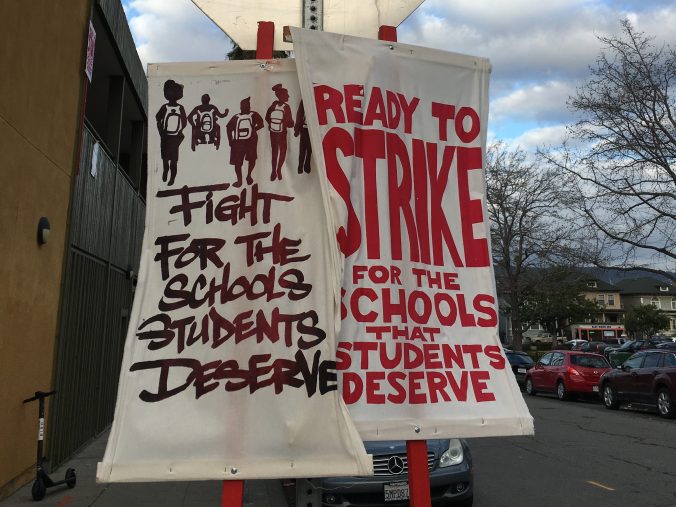
Some of the signs that were used during the 2019 OEA strike. Photo by Craig Gordon
By Craig Gordon, OEA Rank and File Caucus
In October 1995, OEA sent an open letter to parents, teachers and other Oakland residents regarding “underachievement of our students as well as problems of safety, attendance and discipline in our community’s public schools.” It continued:
We have tried unsuccessfully to get the Oakland School Board to solve these problems by reducing class size and properly staffing school sites. Instead, they spend more of their revenue on administration and bureaucracy than any other district in the Bay Area.
Sound familiar? We could send the same letter today, except that things are even worse now. Why have we moved backward instead of forward over the past quarter century?
OEA faces the same fundamental problem that frustrates virtually every union’s ability to defend members’ interests, let alone those of Black, Brown and other working-class people in our community: a failure to identify specific, long-term goals and a strategy to achieve them. Lacking an explicit strategic vision, we settle for whatever minimal, and often short-lived, gains we hope to achieve via labor-management collaboration.
To be clear, “Fight for the schools students deserve,” the slogan that energized our strike in 2019, does imply a very broad goal and suggests a strategy that involves fighting. But what are the specific conditions required for “schools students deserve”? When we concretely outline those conditions—based on research, experience, and common sense—two facts become painfully evident: (1) how very far we are from that goal, and (2) neither OUSD’s top leadership nor the politicians and billionaires behind them will ever “partner” with us to get there. Therefore we must develop a serious fighting strategy to win.
The first step would be for OEA to thoughtfully develop and democratically approve a vision of the conditions necessary for schools students deserve.
Done.
In March 2005, the OEA Rep Council approved a draft of an OEA vision “for creating the best conditions for teaching and learning for all students.” Over the next year and a half, members’ proposed revisions were incorporated into a new draft that was adopted unanimously by the Executive Board and Rep Council. In December 2007, OEA finally printed and distributed thousands of copies of its ten-point vision to members and the public. It was titled “Create Success” in response to OUSD’s empty motto, “Expect Success.”
Here are the highlights of the OEA Vision:
In order to learn and teach successfully, students and teachers need:
-
- A maximum class size of 15 students per teacher
- Sufficient time for teacher planning, collaboration, high-quality professional development and meeting parents and students,
- Qualified teachers and instructional aides in every classroom
- Clean, healthy, safe, comfortable facilities: sufficient space, lighting, ventilation, temperature control, and ergonomic furniture, up-to-date materials and technology.
- Sufficient support staff for academic & extracurricular needs: low student-to-counselor ratio; psychological, social, and medical services, tutoring during and after school hours, adequate campus supervision, and conflict resolution programs.
- Early childhood & adult education programs at each site. Provide parents with easy access to assistance in literacy, English language, and other skills needed to support their children.
- Authority, responsibility, resources and time to authentically assess learning and to better teach students with diverse needs and abilities and to develop rigorous curricula to connect to students’ needs, interests, cultures, races, beliefs, and experiences.
- Resources and training to meet the economic, social, and emotional problems of poverty and racism that many students face.
The OEA Vision concluded by acknowledging the economic reality and strategic necessity it implied:
- obtaining these conditions will require “funding levels many times greater than what we have now,” and therefore
- we must fight to redistribute corporate wealth to achieve it.
Understanding the need for a clear vision and strategy to fight for the schools students deserve, the OEA Rank and File Caucus commits, in our Points of Unity, to “strategize and organize around a vision for what high-quality, liberatory education for all requires, especially for Black, Brown, and working-class students: high-quality learning conditions, including class size at least as small as in elite private schools, far more individual and small-group student support, far more teacher prep time and other material advancements within and beyond schools.”
Coming Next:
Part 2: Tough Lessons that Sparked OEA’s Vision for Quality Public Education
How the 1995-96 OEA strike inspired a campaign to Redistribute Corporate Wealth (RCW), and why RCW needed a vision for high-quality public education.
Part 3: What has OEA done with its vision?
Did OEA use its vision for high-quality public schools to develop and implement a strategy to fight? Why have so few OEA members and supporters today ever heard of this vision?
Part 4: Where do we go from here?
What steps are needed to finally turn the tide in the fight against school privatization and begin to make real progress toward the public schools students deserve?


Pingback: Tough Lessons that Led to OEA’s Vision for Quality Public Education | Oakland Rank and File Caucus